

Medically reviewed by Richard M. Kratzenberg, PA-C · Published November 7, 2026
Most Botox treatments go exactly as planned, and the most common side effect is a small bruise that fades in a week. But every so often something is off: a lid that feels heavy, a brow that went flat, a smile that pulls to one side. If that is you, take a breath. Almost all of it is fixable, most of it is temporary, and at Simply Injectables in Providence we have been correcting it for over 15 years.
First, the honest numbers
Eyelid droop is the complication people fear most, so here is what the data says. In the FDA clinical trials for Botox Cosmetic, eyelid droop occurred in 3% of patients treated for frown lines (13 of 405), and brow droop in 2% of those treated for forehead lines (Botox Cosmetic prescribing information). Experience matters: a large study put the rate at 5.4% for inexperienced injectors and under 1% for experienced ones (Aesthetic Surgery Journal, 2023).
Under 1% is still not zero. Anatomy varies from person to person, and every injector who has been doing this long enough has seen it happen. It is a numbers game, and the honest injector tells you that before you sit in the chair. What we cannot do is tell you what happened at the last place. What we can do is tell you exactly what to do now.
Is it your eyelid or your eyebrow? The question that changes everything
You have been staring in the mirror for a week saying “my eyelid dropped.” Then you come in, and it is not your eyelid at all. It is your eyebrow. The fix is completely different, so this is the first thing we check. Here is the difference:
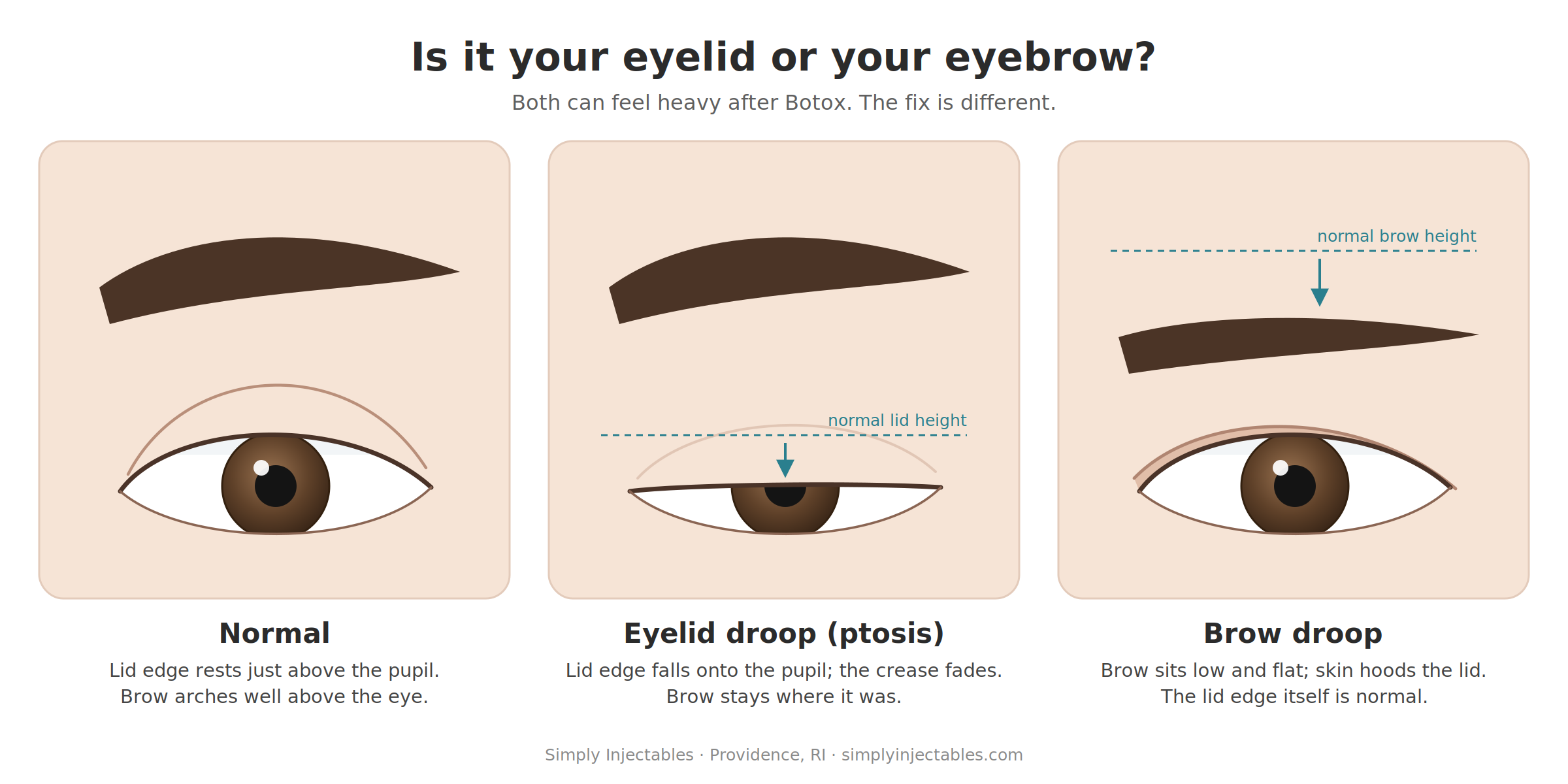
A true eyelid droop (ptosis), the middle face above. The edge of the upper lid itself sits lower, covering more of the colored part of your eye and sometimes the top of the pupil. The eyelid crease looks softer or disappears. The brow is usually in its normal place. It shows up 3 to 14 days after injection, and the cause is a small amount of Botox reaching the levator, the muscle that lifts your lid (Aesthetic Surgery Journal, 2023).
A heavy brow (brow ptosis), the face on the right. The brow sits lower and flatter, straight across, and the brow skin folds down onto the lid. The lid edge itself is fine. You feel heavy and sleepy, people tell you that you look tired, and some patients get a dull forehead ache from trying to lift. The cause is too much Botox in the frontalis, the only muscle that raises your brows, especially low on the forehead, without enough in the muscles that pull the brow down.
Fixing a dropped eyelid: drops, a precise lift, and time
1. Prescription eye drops, the same day. Once we confirm it is the lid and not the brow, we call apraclonidine 0.5% in to your pharmacy. It stimulates Müller’s muscle, a second lid-lifting muscle the Botox did not touch, and gives a small, quick lift. Upneeq (oxymetazoline 0.1%) is the branded, FDA-approved drop that works the same way; in trials it lifted the lid an average of 1 mm per drop, taking effect within 5 minutes to 2 hours and lasting 6 to 8 hours (Healio). It is expensive, so we prescribe it when the generic is not enough. For a mild droop of 1 to 2 mm, drops alone can carry you through.
2. A little more Botox, right at the lash line. Afraid of more Botox? Don’t be. The lid is opened by the levator and closed by a thin band of muscle along the lash line. Weaken that closing muscle by a hair and the lid opens up. In a 2023 case series, 2 to 4 units placed there, with Upneeq, lifted severe droops by an average of 3.4 mm within 10 to 14 days in all 8 patients, with no complications (Aesthetic Surgery Journal, 2023). This is the same technique we use for patients with naturally heavy lids, and we do it all the time.
3. Time is on your side. Botox-related lid droop usually fades in a few weeks and lasts up to 2 months at most. It leaves long before the rest of your Botox does.
Fixing a heavy brow: more Botox, placed smartly
This one surprises people. The answer to a brow that is too low is not to wait it out; it is to treat the muscles pulling the brow down so the brow can float back up. We make sure the glabella (the frown muscles between the brows) has a full dose, and we release the tail of the brow where the vertical frown muscle meets the lateral eye muscle. Nothing more goes into the forehead. The lift is usually visible within a week.
If one brow is peaking instead, the “Spock brow,” that is the opposite problem: the outer forehead was under-treated. One or two units above the peak settles it.
Either way, Botox wears off in 3 to 4 months. These are easy fixes.
Can a saline injection reverse Botox? You may read online that injecting saline into a heavy brow “reverses” it. It does not. Within hours the toxin is inside the nerve ending, where nothing injected afterward can reach it. A 2025 study modelled the claim in 30,000 patients: plain saline changed nothing, and bacteriostatic saline shortened a six-week recovery by an average of 6.5 days, with no patient recovered by day 14 (Toxins, 2025). Treating the muscles that pull the brow down is the fix that works.
One brow higher than the other? Sisters, not twins
Nobody’s face is symmetric, and Botox is personalized to the millimeter. Every once in a while you will need an adjustment, and that is normal. No one is going to be mad at you for coming back. We want you to have the best result, and a two-week check is the easiest way to get there.
A lopsided smile after chin or DAO Botox
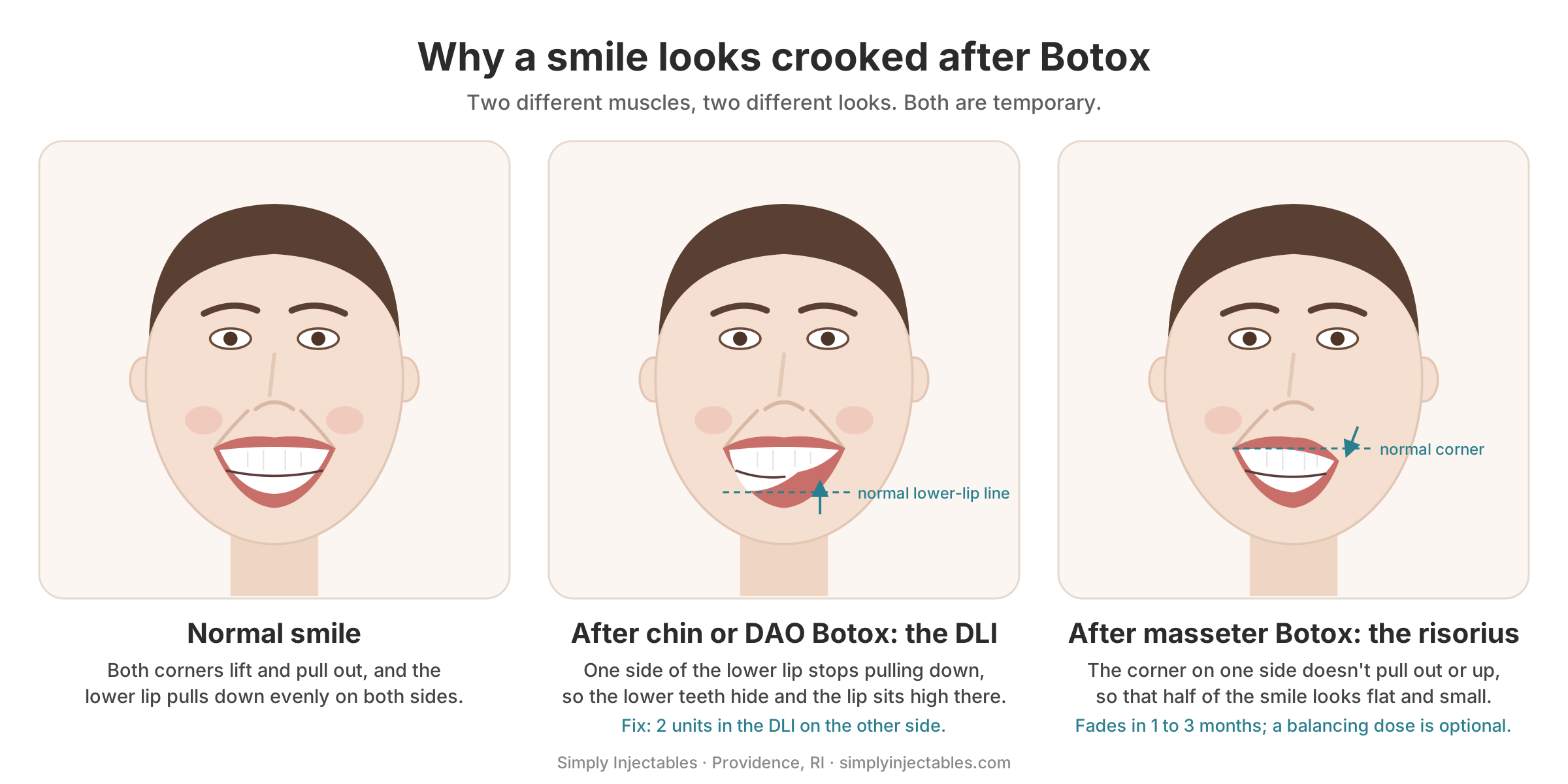
You had Botox in your chin for dimpling, or in the DAO muscles to lift the corners of your mouth. Now one side of your smile looks like it stopped working, like the middle face above. Here is why: the muscle that pulls your lower lip down when you smile (the depressor labii inferioris) sits right beside both of those targets. A few units drift over, one side of the lower lip stops moving, and the smile goes crooked. It appears within the first two weeks.
The fix is to even things out: 2 units into the same muscle on the other side. Balancing the opposite side is an accepted way to correct toxin-related asymmetry (Aesthetic Surgery Journal Open Forum). You will show a little less lower lip when you smile for a few weeks, but it will be even. If we did your treatment, there is no charge. And it fades on its own within weeks either way.
One safety note: if a facial droop appears suddenly without a recent injection, or comes with arm weakness or slurred speech, that is an emergency. Call 911.
Masseter Botox and a smile that changed
Masseter Botox for grinding and jaw slimming is one of our favorite treatments. When it goes wrong, it is almost always placement, and it looks like the face on the right in the illustration above: injected too high or too far forward, the Botox reaches the risorius or the zygomaticus, the muscles that pull your smile out and up. The risorius attaches to the masseter in more than 97% of people, which is why the margin for error is small. In a study of 2,036 masseter treatments, a limited or uneven smile occurred in 0.15% and recovered in 1 to 3 months (Peng, 2018).
Prevention is a safe zone: stay below the line from the corner of your mouth to your earlobe, keep to the lower, back part of the muscle, and inject deep into its belly. Correction is a judgment call. Often the right move is to leave it and let it fade. Sometimes a small balancing dose on the other side is worth it. We will tell you which.
How to lower your own odds
If everything is done right and you are still the rare person this happens to, it is not your fault. But these habits help:
- Do not press, rub, or massage the treated area for 24 hours, and skip tight hats and headbands.
- Stay upright for 4 hours after treatment.
- Skip the workout for 24 hours.
- We would rather you did not fly the same day.
- Tell your injector about any previous droop, eyelid surgery, or naturally heavy lids before you are treated.
Our correction policy
If we did your Botox, corrections are complimentary: tell us at the two-week mark and come in within two to three weeks. We check in with every patient after a first treatment, so you will hear from us before you have to chase us. Past two months you are close to your next cycle anyway, and we will be reasonable about it.
You don’t have to wait it out
Three months is a long time to feel like you look tired. If your Botox is not right, whether we did it or someone else did, call Simply Injectables at 401-648-7475 or book a correction visit at 237 Wayland Avenue in Providence. We will look, tell you honestly whether it is the lid or the brow, and fix what can be fixed that day.
Frequently asked questions
How long does a droopy eyelid from Botox last?
Usually a few weeks, and up to 2 months at most. Drops and a small pretarsal Botox treatment can shorten that to days.
Can a Botox droopy eyelid be fixed?
Yes. Prescription drops (apraclonidine or Upneeq) give an immediate 1 mm lift, and a precise pretarsal injection can add 2 to 3 mm within two weeks.
Why do I look tired after Botox?
Most often the brow dropped, not the lid. Treating the muscles that pull the brow down lifts it back up.
Can Botox cause a crooked smile?
Yes, after chin, DAO, or masseter treatments, when the toxin reaches a neighboring smile muscle. It is temporary and can be balanced.
Will you fix Botox done somewhere else?
Yes. We will not guess at what happened there, but we will assess you and treat what we can.
This post is for education and is not a substitute for an in-person assessment. Results vary from person to person.